
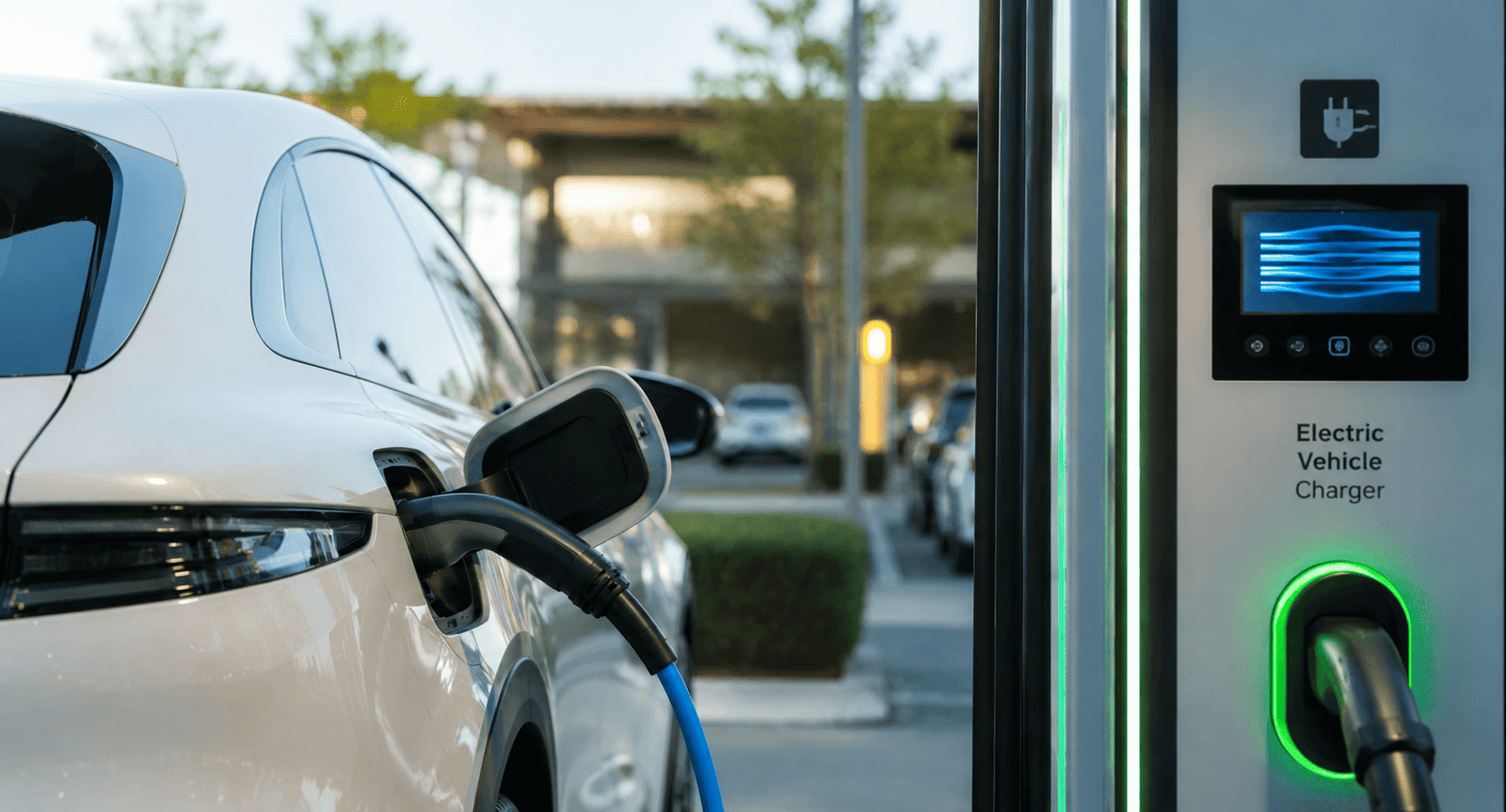
Electric vehicles (EVs) are transforming the automobile industry. What once seemed like a niche alternative to petrol and diesel vehicles is rapidly becoming a major automotive technology platform—combining batteries, electric motors, power electronics, software, connectivity and increasingly advanced charging systems.
But how does EV technology actually work? What makes an electric vehicle different from a conventional car, and what innovations could shape the next generation of EVs?
What is EV Technology?
EV technology refers to the systems that allow a vehicle to use electricity as its primary source of propulsion. In a battery electric vehicle (BEV), electricity is stored in a high-voltage battery pack and delivered to one or more electric motors.
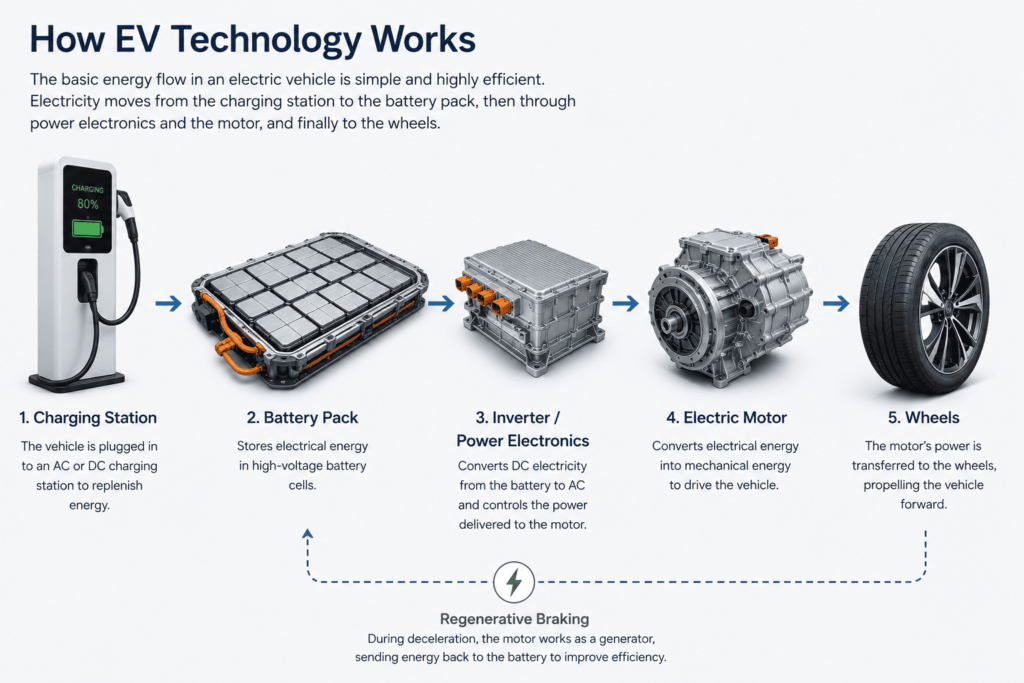
Unlike an internal-combustion engine vehicle, an EV does not need a petrol or diesel engine, fuel tank, transmission system with many mechanical components, or exhaust system.
The basic energy flow is:
Charging station → Battery pack → Inverter/power electronics → Electric motor → Wheels
Modern EVs also depend heavily on software to monitor the battery, manage energy consumption, control vehicle functions and optimize performance.
The EV Battery: The Heart of the Vehicle
The battery pack is one of the most important components of an electric vehicle. It stores electrical energy that can later be converted into mechanical energy by the motor.
Most EVs today use lithium-ion battery technology. Battery packs contain many individual cells arranged into modules or larger pack structures.
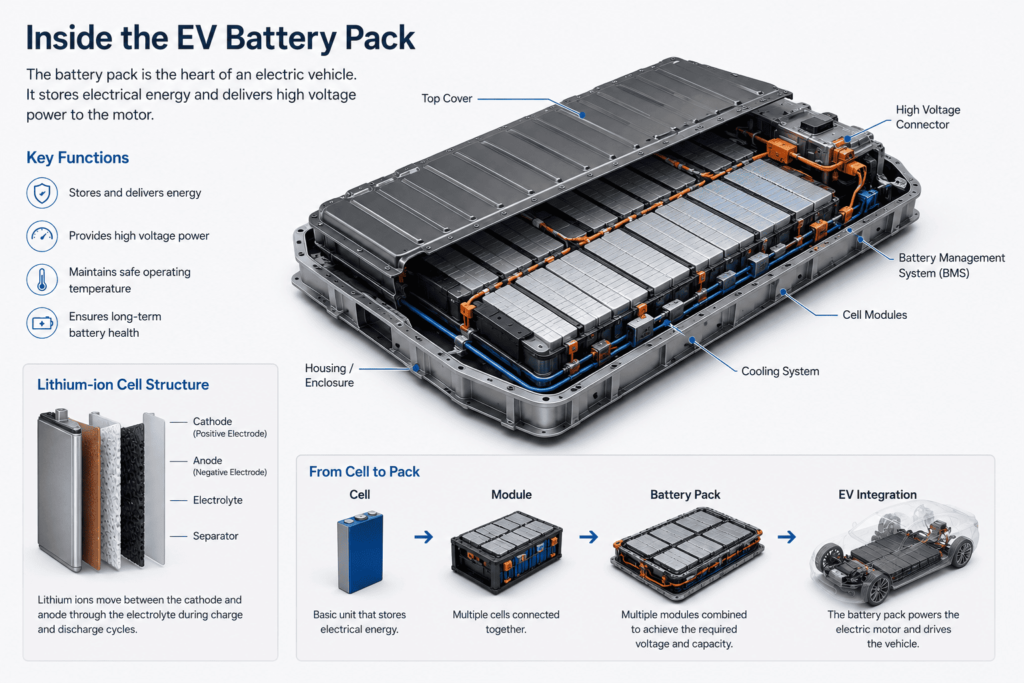
The main components of a lithium-ion cell include Cathode, Anode, Electrolyte, Separator.
Different battery chemistries offer different combinations of cost, energy density, performance and durability.
Lithium iron phosphate (LFP) has become particularly important. According to the International Energy Agency, LFP accounted for more than 55% of EV batteries deployed globally in 2025.
Battery technology is also advancing rapidly. New pack designs, improved cell manufacturing and better thermal management are helping manufacturers increase performance while reducing costs.
Battery Management System (BMS)
A large EV battery cannot simply be treated as one giant battery. It contains many individual cells that must be monitored and controlled. This is the job of the Battery Management System (BMS). The BMS monitors factors such as:
- Cell voltage
- Battery temperature
- State of charge
- Charging and discharging current
- Battery health
- Cell balancing
It can reduce or stop charging and power delivery when operating conditions become unsafe.
An advanced BMS can also help manufacturers optimize battery performance and estimate remaining range more accurately.
Electric Motor
The electric motor converts electrical energy into mechanical energy that turns the wheels. Electric motors have several important advantages over combustion engines. They can deliver high torque almost immediately and generally have fewer moving parts. Depending on the vehicle design, manufacturers may use different types of motors, including permanent-magnet synchronous motors and induction motors. Some EVs use a single motor, while performance-oriented and all-wheel-drive vehicles can use two or more motors.
Inverter and Power Electronics
The battery stores electricity as direct current (DC), while many EV motors operate using alternating current (AC). The inverter manages this conversion and controls how much electrical power reaches the motor. Power electronics are therefore crucial to acceleration, efficiency and regenerative braking.
Recent advances in power electronics are also helping EV manufacturers move toward higher-voltage electrical architectures. Higher voltage can enable greater charging power without requiring proportionally higher current.
The IEA reports that the first 1,000-volt electric car models appeared in 2025, alongside continued development of ultra-fast charging systems.
Regenerative Braking
One of the most interesting features of EV technology is regenerative braking. In a conventional car, braking converts much of the vehicle’s kinetic energy into heat through the brake system. An EV can instead use its motor as a generator during deceleration. The vehicle’s motion drives the motor, producing electrical energy that can be sent back to the battery. This process is called regenerative braking. It can improve energy efficiency and reduce the amount of work required from conventional friction brakes.
EV Charging Technology
Charging is another major area of EV innovation. There are broadly three charging situations:
AC Charging
AC charging is commonly used at homes, workplaces and many public charging locations. The vehicle’s onboard charger converts AC electricity into DC electricity suitable for the battery.
DC Fast Charging
DC fast chargers deliver DC power directly to the vehicle’s battery system, allowing much higher charging power than typical AC charging. This is particularly useful for highway travel and long-distance journeys.
Ultra-Fast Charging
New high-voltage architectures and improvements in batteries and power electronics are pushing charging speeds much further. In 2026, manufacturers are announcing systems capable of adding substantial range in just a few minutes, although the real-world experience depends on the vehicle, charger, battery temperature, charging curve and infrastructure. The technology is advancing quickly, but widespread and reliable high-power charging infrastructure remains just as important as the vehicle itself.
Smart Charging and Vehicle-to-Grid Technology
EVs could eventually become more than transportation devices. With smart charging, vehicles can automatically charge at times when electricity is cheaper or when demand on the power grid is lower. An even more advanced concept is Vehicle-to-Grid (V2G). V2G allows a compatible EV to send electricity back to the grid when needed. In effect, a fleet of parked EVs could become a distributed energy-storage resource. Commercial V2G offerings for private EV owners began appearing in 2025, although the technology is still limited by vehicle availability, regulations and standards.
Software-Defined Electric Vehicles
Modern EVs are increasingly becoming software-driven machines. Software can control everything from battery management and charging to climate control, driving modes and driver-assistance features. Many newer vehicles also support remote software updates, allowing manufacturers to improve features without requiring a traditional workshop visit.This is one reason EVs are closely associated with the concept of the software-defined vehicle. The IEA notes that battery electric vehicles are currently at the forefront of this transition because their relatively simple electric drivetrains are particularly compatible with digitalization and automation.
Thermal Management
Temperature has a major effect on battery performance. An EV battery needs to operate within an appropriate temperature range for performance, charging capability and longevity. Modern vehicles therefore use sophisticated thermal-management systems to heat or cool the battery. This becomes particularly important during fast charging, when the battery can generate significant heat. Temperature management can also affect driving range in very hot or cold weather.
New Battery Technologies
Lithium-ion technology continues to improve, but researchers and manufacturers are also exploring alternative technologies.
Sodium-Ion Batteries
Sodium-ion batteries are attracting attention because they can reduce dependence on lithium and can offer good performance at low temperatures. However, their energy density is currently lower than leading lithium-ion technologies, which limits their use in some long-range applications.
Solid-State Batteries
Solid-state batteries replace the conventional liquid electrolyte with a solid electrolyte. They are being developed with the potential for higher energy density, improved safety and potentially faster charging. However, large-scale manufacturing remains challenging, and the technology is not yet ready to replace conventional lithium-ion batteries across the mass market.
Battery Recycling and Second Life
EV technology doesn’t end when a vehicle leaves the road. Battery recycling will become increasingly important as today’s growing fleet eventually reaches the end of its useful life. Battery materials such as lithium, nickel, cobalt and other components can potentially be recovered and reused. There is also growing interest in giving used EV batteries a second life in stationary energy-storage applications. The timing is important: because EV batteries can remain in service for many years, the large-scale flow of end-of-life EV batteries is expected to increase substantially in the 2030s.
The Role of AI in EV Technology
Artificial intelligence is becoming increasingly relevant to electric vehicles. AI and machine learning can be used for applications such as:
- Battery health prediction
- Range estimation
- Charging optimization
- Manufacturing quality control
- Predictive maintenance
- Driver-assistance systems
- Energy-management optimization
The combination of powerful computing, sensors, connectivity and electric powertrains is making vehicles increasingly software-centric.
The Future of EV Technology
The next generation of electric vehicles will likely be defined by improvements across the entire technology stack—not just bigger batteries. We can expect continued development in:
- Higher-energy-density batteries
- Faster charging
- Higher-voltage architectures
- Improved battery-management systems
- More efficient electric motors
- Silicon-carbide and other advanced power electronics
- Sodium-ion and solid-state batteries
- Vehicle-to-grid systems
- AI-powered software
- Battery recycling
- More integrated battery-pack designs
Battery pack energy density has already increased substantially over the past decade, while battery prices have fallen significantly, creating room for further improvements in EV affordability and performance.
Conclusion
EV technology is much more than simply replacing a petrol engine with an electric motor. It represents a fundamental redesign of the automobile around batteries, electronics, software and digital control.
The biggest advances are happening simultaneously in batteries, charging infrastructure, power electronics, thermal management, software and energy systems.
As these technologies mature, electric vehicles are likely to become faster to charge, more efficient, smarter and increasingly integrated with the electricity grid.
For consumers, businesses and the automotive industry, understanding EV technology is becoming essential—not only because of the growth of electric cars, but because EVs are helping redefine what a modern vehicle can be.






Leave A Comment