

In recent years, the world has been undergoing a major technological transformation. Emerging technologies such as Artificial Intelligence (AI), Internet of Things (IoT), Blockchain, 3D Printing, and drones are no longer limited to the realm of science and technology and are increasingly influencing the lives of ordinary people. According to IoT Analytics, there were around 16.6 billion IoT devices in the world at the end of 2023, more than the total population of the world. According to Forbes, the number of IoT devices has more than doubled in recent years, from 10.3 billion in 2018 to 25 billion in 2025.
The widespread use of smartphones has enabled the intervention of emerging technologies, allowing individuals to connect locally and globally to vast pools of human resources, devices and information, thereby enhancing their knowledge and awareness of the latest innovations. According to a survey by Department of Telecom, Government of India, conducted between January and March 2025 involving 1.42 lac people, 95.5% of individuals aged 15-29 owned a smartphone, and 92.7% of them accessed the internet. This demonstrates that almost every individual now represents a node in the digitally interconnected world.
However, despite rapid growth in mobile and internet connectivity over the past two decades, the adoption of emerging technologies in India remains limited. A recent Google survey indicates that 60% of Indians are either unfamiliar or have very little knowledge of AI, and only 31% have experimented with generative AI. While AI-based courses are increasingly gaining popularity among undergraduate students, their penetration at the school level remains restricted due to the unavailability of adequately trained faculty. There is a strong need to create dedicated trained engineering faculty positions in schools, ensuring early exposure to emerging technologies and building a future-ready workforce.
The enablers across government as well as private sectors are working proactively to aware people, generate skilled manpower, develop indigenous solutions and promote adoption of emerging technologies to enhance productivity and improve efficiency in day-to-day tasks. The Government of India launched the IndiaAI Mission on March 7, 2024 (www.IndiaAI.gov.in) to accelerate indigenous development of AI based technologies. With a budget allocation of ₹10,354 crore, the mission aims to build a comprehensive ecosystem that fosters AI innovation by democratizing computing access, enhancing data quality, and developing indigenous AI capabilities. The startup incubators established under NITI Aayog’s Atal innovation Mission, DPIIT’s Startup India Initiative, DST-GoI supported NIDHI Scheme, RAFTAAR scheme of Ministry of Agriculture & Farmers Welfare and others are taking lead in nurturing tech-based startups in the country.
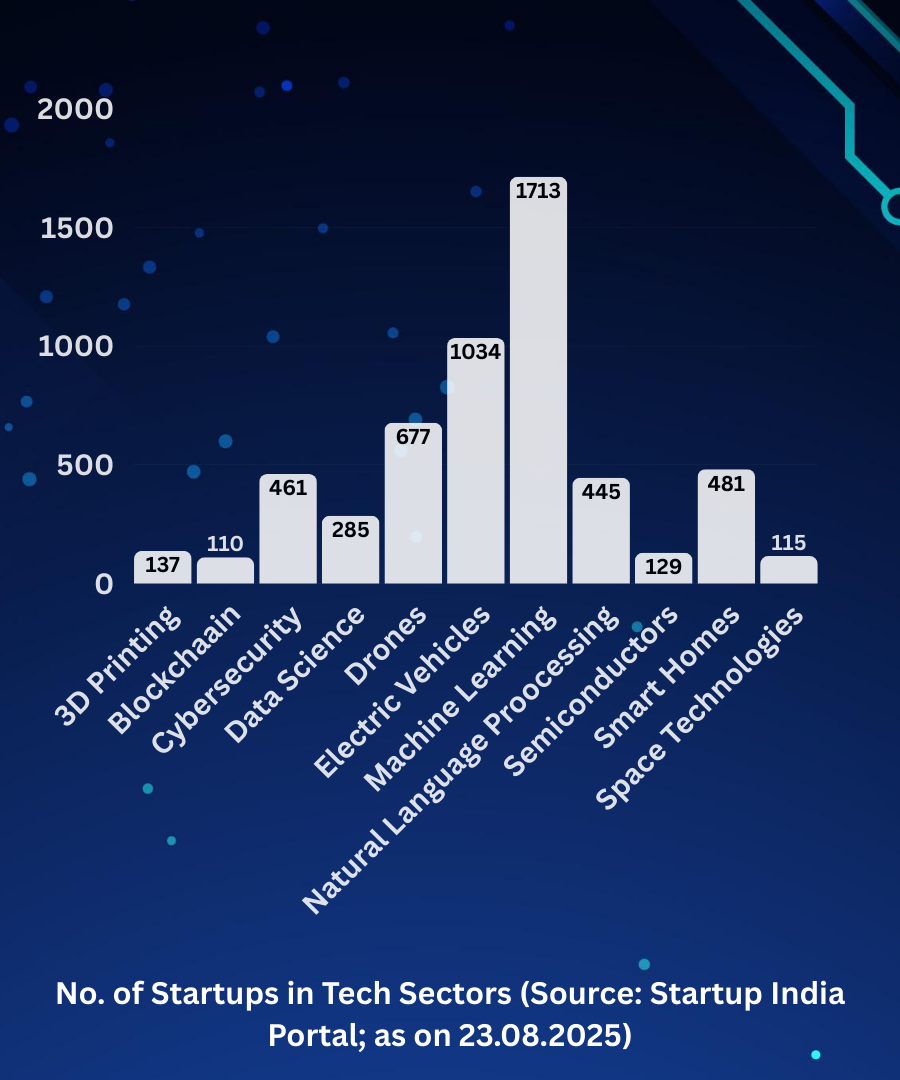
The number of startups working in emerging technology domains remains relatively small. As of August 2025, Startup India Portal lists a total of 1.77 lakh startups, but only a few operate in specialized areas such as 3D Printing (137), Blockchain (110), Space Technologies (115), Data Science (285), Semiconductors (129), Smart Homes (481), Drones (677), Cybersecurity (461), Electric Vehicles (1,034), Machine Learning (1,713), Robotics (630), and Natural Language Processing (445).
The drone technologies are gaining traction in key sectors such as defense, agriculture, and logistics. A survey by Nexgen Expo, conducted among 150 drone manufacturing companies in India, projects that agriculture and precision farming will be the largest consumers of drones by 2030. The major challenge in adoption of drones in India, such as those used in agriculture and other sectors, lies in their high end costs. This is due to the reason that Indian drone industry is dependent on import of more than 60% of drone’s components. Recently, Government of India has planned to launch Rs. 2,000 crores incentive scheme to promote indigenous drone manufacturing in the country. The government is also encouraging their use across sectors, and developing skilled manpower for drone operations. One notable initiative is the ‘Pushpak – National Mission on Drone Technology,’ led by IIT Bombay with a budget of ₹82.7 crore. This mission involves institutions viz. CDAC Thiruvananthapuram & Bengaluru, IIT Gandhinagar, IISER Bhopal, VJTI Mumbai, and KARE Tamil Nadu, focusing on the development and deployment of indigenous drone technologies. Additionally, the Central Government launched the ‘Namo Drone Didi’ scheme in 2024 to empower 15,000 women-led self-help groups as drone service providers, enhancing agricultural efficiency and promoting local entrepreneurship. Under this scheme, 14,500 drones have been approved, with more than 1,000 already distributed across India in 2023-24. These government initiatives are further complemented by private sector efforts. For instance, the Drone Federation of India, with support from Amazon Web Services, launched the ‘Adopt Drones Program’ to accelerate the adoption of AI-driven drone solutions.
Another transformative technology gaining global attention across infrastructure, healthcare, industry, and space is 3D printing. The Ministry of Electronics & Information Technology (MeitY), Government of India released National Strategy on Additive Manufacturing in February 2022 to encourage domestic manufacturing, value addition in machines, reduce imports, establish national centers on additive manufacturing and promote research, innovation and adoption of these technologies. MietY has set-up seven thematic centers for additive manufacturing in academic institutions at Hyderabad (for sustainable ecosystem), Mehsana (Gujrat), Pune (opto-Electronics), Vishakhapatnam (Medical Devices), Kolkata (Agri & Food Processing), Mandi, Himachal Pradesh (Renewable Energy) and Bengalore (Optical Computing Chips). According to an answer to a Lok Sabha question dated 07.08.2024, under this initiative, 5 centers have been created, 22,000+ manpower trained and 40+ startups engaged in 3D printing technologies. Further, with a vision to generate one million young innovators in the country, NITI Aayog under its Atal Innovation Mission has set-up more than 10,000 Atal Tinkering Labs in schools. These Labs are equipped with 3D printers enabling students gain basic learning experience in additive manufacturing techniques and its applications. The equipment database portal iStem developed by IISc Banglore lists several 3D printing machines available across academic & research institutions in the country for use by researchers and industry to conduct state-of-the-art research.
As India stands on the brink of a technological revolution, the convergence of government initiatives, academic involvement and private sector participation presents a promising pathway toward a digitally empowered future. While challenges such as limited awareness, high dependency on imports, and skill gaps persist, the ongoing efforts to build indigenous capabilities, promote innovation, and integrate emerging technologies across sectors are paving the way for inclusive and sustainable growth. With its vast pool of STEM talent and a rapidly expanding digital infrastructure, India has the potential not only to adopt but also to lead in shaping the global emerging technology ecosystem. The journey ahead requires sustained collaboration, policy support, and a forward-looking mindset to unlock the potential of these transformative technologies for every citizen.


Leave A Comment